Thursday, August 13, 2009

Restaurant # 7: Kosendo, Tour Guide's Choice


This was our second day in Kyoto, and we decided to go with a tour guide, mainly for info on the locations rather than having her choose the locations herself, as we already had an itenary planned for the day. After visiting GinkaKuji, along with another temple, the Nishiki food market and Nijo castle, it was time for lunch.
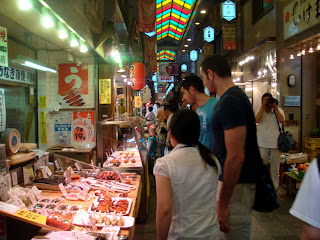


The food market was an interesting experience, the most common foods, typical Kyoto specialties included pickles, tofu and agricultural produce.


Interestingly, when we were in the vicinity of Nishiki Market, a camera crew from one of the local TV channels approached us for an interview, due to our exotic appearance (in Japan at least). However, when they realized that we were not europeans, their interest in us waned somewhat. (The TV crew asked where we were from, and after I answered lebanon, they presented me with a map of europe to point out where it was.)
It was very common for random locals to come up to us and try to guess our nationality, people in Kyoto are very curious about foreigners, albeit in a very friendly manner ofcourse.
Nothing works your appetite quite as much as exploring serveral temples/castles in the span of 5-6 hours.
For this day we decided on having lunch at a place popular with the locals, rather than a high end restaurant and we went with the tour guide's choice. This was her favorite restaurant in Kyoto so we thought we would give it a shot.


The restuarant itself was a cozy, traditional, little place that seemed popular with locals (we had to wait a few minutes for a table).


The menu seemed colurful enough. Shame no english menu was available. There were two choices for main course, either deep fried chicken "Kyoto style" or Oden (Several ingredients stewed in a Dashi-Soy broth).
If someone can kindly translate the name of the restaurant from the menu (assuming that it is mentioned on there somewhere) I would be much obliged.


The meal looked extremely neat, with all the plates arranged neatly on the tray. Clockwise from top left: Enoki mushroom miso soup, Pumpkin cake dessert, Crab radish cucumber mayo salad, Deep fried chicken cutlets stuffed with a pickle relish, Nama-fu served with a sweet miso dipping sauce (wheat gluten, a high protein meat substitute popular in buddhist cuisine, and especially popular in Kyoto) and finally plain rice and pickles.
The Nama-fu was the star of the show, it was delicious! It was very chewy. The story goes that buddhist monks had got fedup with their vegetarian diets owing to the "weak" textures of vegetarian foods as opposed to meats, and they came up with this dish to mimic the chewy texture of meats.The Japanese (east asians in general actually) love their food to have chewy/unusual texture, often giving texture precedence to taste (examples are konnyaku jelly and sea cucumber among a long, long list) . Texture plays a minimal role in middle eastern cuisines, or even european cuisines, at least in the sence that no foods are valued based on texture alone.


The others ordered the above, but i opted for the more Japanese option of Oden. Although fried foods are extremely popular in Japan, and have been for a long time, they were brought to Japan by the Portuguese, and since Oden is as Japanese as it gets, my choice was obvious.
The meal was identical to the one above with the exception of the oden.


Although Oden was traditionally a winter plate, it was one of the things i had to try while in Japan. Oden is a very typical Japanese plate and is not well known outside of Japan, its ingredients appealed specifically to the Japanese palate. The contents were: Clockwise from top left, a boiled egg, konnyaku jelly (jelly made from the konjak plant) which had very little taste and was gelatinous in texture, deep fried tofu, a turnip, and a cylindrical shaped form of kamaboko. (fishcake)

The meal cost 2200 JPY (24 USD) per person. Not bad for such a filling meal. We also got a genuine taste of everyday foods that the locals eat.

Tuesday, August 11, 2009

Restaurant # 6: Tamahan Ryokan


After searching extensively on the internet for a Ryokan (Traditional Japanese Inn) in Kyoto, we came accross Tamahan.
It was situated in Gion, just a few minutes walk from the Kiyomizudera and Kodaiji Temples.
If you haven't been to Gion, the old district of Kyoto, you will have some difficulty in understanding just how beautiful the place is, its like traveling 150 years back in time to a bygone era that only exists in Gion, and perhaps a few other places in Japan.


If you take a peek into any of the townhouses in the Gion area you will see just how splendid they are. With perfectly trimmed Japanese style gardens and genuine traditional style wooden structures. The streets and walkways are really neat and clean. The only sign here that you are indeed in the 21st century is the occasional vending machine.


If you are lucky, actually, more often than not... You will come across a Geisha, or a Maiko rather (apprentice geisha). Although the majority of them will be just tourists dressed up as Geisha, should you come accross a real Maiko you will be able to tell the difference quite easily.
As you can see, Gion offers a sublime blend between the traditional and hints of modernity, where the tranquility is often tainted by the occasional "Cans Shop"! :)


Arriving at Tamahan revealed to us just how beautiful the Ryokan was, we were glad we had four days to spend there. We were scheduled to have dinner at the Ryokan, so we went out for a bout of Gion exploration before heading back here for dinner.


A view of the Ryokan's main entrance.


I personally opted for parting with modern conveniences throughout the duration of our stay in Gion, in order to be better immersed in the Ryokan experience, Walid on the other hand, had no such intention. You can see Tamahan's spectacular inner garden through our room window.
We had two rooms, situated one above the other.


What better way to have dinner in the Ryokan than dressed in traditional attire...
On to the food. Excuse my descriptions, as we neither got a menu, nor had an english speaking waitress so ill try my best to describe what the food items actually were.


First course was Tofu in a simple Dashi based broth and some White fish Sashimi.
Very elaborately presented as you can see.


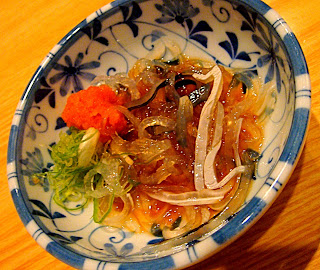
This course will be harder for me to describe, excuse my memory lapse.
At the top of the plate was a spinach, enoki mushroom and tofu salad in the smaller white plate, clockwise next is a rolled piece of stuffed eel, next is a slice of jellied octupus, Edamame, a slice of sweet potato, a shrimp on a sweet yellow paste that had the texture of hard boiled egg yolk, and finally a slice of some sort of dried fish.


A simple Chawan Mushi (Egg custard flavored with dashi, soy sauce and mirin). No toppings or fillings had been added, probably to emphasize the delicate taste af the Chawan Mushi, showing off the chef's skills.


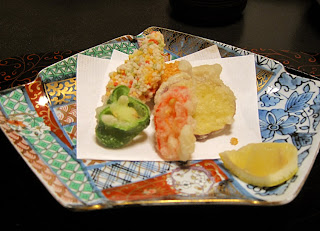
Here was the deep fried course, served with a lemon wedge and Matcha salt.
It was skillfully prepared and retained very little oil.
There was a green pepper, a red pepper, a slice of sweet potato, and two varieties of fish, one of which was coated with little multicolour crumbs.


This was a whole fish head cooked with bamboo in a sweet sauce.
It was the best course of the meal. Although it was my first time having a "fish head" and the idea did not seem appealing to me at first, it did have quite some meat on it, although i did avoid the eyeballs, which my brother Walid tried. Apparently the eyeballs are extremely fishy tasting, glad I avoided them!


A broiled King prawn basted with a sweet sauce, again, this was very good.


This was eggplant coated with black and white miso. Kyoto eggplants are exceptionaly sweet and moist. The quality of fruits and vegetables in Japan is astounding, I would go as far as to say they are the best in the world.


Please excuse the low quality of this photo, unfortunately, i cannot recall what this plate was!
After this they server us some plain steamed rice, which we were too full to eat.


The dessert was simply some cherries in a glass of ice water. Just as expected from Japanese fruits, these were very sweet and juicy.


Breakfast was no less fancy, a typical breakfast included several plates and the choice was either Japanese or western. Naturally, I sided with Japanese: (although the Japanese breakfast did differ from day to day)


The plate on the right was a Chawan Mushi (Egg Custard) with mushrooms and prawns, very tasty. On the left hand side was yogurt with blueberries and avocado. Curious as to why they would serve this as part of a Japanese breakfast as neither yogurt nor avocados for that matter are traditional Japanese foods, rather they are more recent imports.
On the top left was a plate of pickles. Not pictured here was a bowl of plain steamed rice.


Deep fried Tofu in a dashi-soy sauce broth topped with chopped seaweed.


Delicoious Miso soup with Enoki mushrooms and Rolled Omelette.
Tamahan's breakfasts were quite memorable, much needed calories to sustain our 12 hours of walking daily routine.


Here I am with the two tamahan attendants to my left and right, and the Obasan on the right hand side of the picture was the owner of Tamahan. I can not say enough good things about the service there or the owner herself for that matter, they were most courteous, friendly and accomodating.
The prices were not cheap, and can be seen in detail on their website, but for a high end Ryokan I think that this was the best that Kyoto had to offer. Located right in the heart of Gion, excellent food, and excellent service.

Monday, August 10, 2009

Restaurant # 5: Izu


After spending two days exploring Osaka and Nara, we headed to Kyoto for the next four days of our trip. The first lunch that we had was at Izu, one of the oldest makers of Kyo-Zushi (Kyoto style sushi) around.
Their web address is: http://r.gnavi.co.jp/izu/
Since Kyoto is landlocked, this traditional style of sushi does not involve fresh fish, but rather involves a variety of toppings ranging from pickled Saba (Mackrel) to Tamago (Egg omlette).
We went to Izu for a quick lunch and sampled what few varieties that were on offer.


Unfortunately the only image that I could find on my camera was a partial outside view of Izu.
Hopefully I will find some images of the interior on my sister's camera and upload them later.
The inside was what i can best describe as rustic, with wooden benches desigend for a quick meal, and most customers that we saw opted for takeout. It was extrmely neat and genuine looking, and i have no doubt that it has looked exactly the same way for over a century.


The meal itself was very simple, consisted of a cup of green tea and the above plate.
The sushi varieties were: on the bottom of the plate left hand side, Saba Zushi (Pickled Mackrel), next came the big roll that had in it pickled radish, tamago (egg omlette) and very sweet pickled mushrooms.
The Saba Zushi was far too fishy tasting for my taste, i did not enjoy the Saba at all, although my brother Walid did take to its liking. The other large roll was very sweet in flavor (owing to the sweetened mushroom and tamago) and was indeed very large. This large sushi was actually very good, but tasted more like a dessert than a sushi roll. I would best describe it as a rice cake.
On the top of the plate there were five varieties of box pressed, cube shaped sushi which consisted of the following:
Ebi (shrimp), Tamago (Egg Omlette), Hamo (Pike conger basted with a sweet sauce), Torigai (A variety of cockle), and finally Tai with Kinome (Sea bream with shansho leaf).
These small sushi were mostly rice with a very thin layer of topping for flavor mostly. They were all mild tasting, rice being the first and foremost ingredient, and it contributed most to the taste of the sushi. I did especially like the Hamo, although I thought it distinctively tasted like roast beef!


Walid, absolutely loved the big rolls, so we opted for another order. The initial order by itself was filling but we are big eaters.


As you can see, we could barely fit the roll in our mouths. :)
I guess as a traveller exploring Japan and sampling the local cuisine, trying out traditional places like this is a must. However, if you are only looking to eat the best tasting dishes available rather than sampling the local specialties, you could find many tastier alternatives in Kyoto.

I can not say how this restaurant compares to others serving the same fare since this is the only Kyoto style sushi place that I have ever visited, however i remember it being quite expensive at 13,000 JPY (141 USD) for the four of us, considering that our meal consisted of little more than flavored rice.


Restaurant # 4: Fuku Fuku Fugu in Osaka


After spending two days in Tokyo, we headed to Osaka.
Osaka has a reputation for being a foodlover's paradise. After a long day of exploration, and sampling several Osaka streetfoods which I hope to discuss later, the time was right for a large multi-course Fugu meal!
Now the best season for Fugu was during winter, however, since i cant visit Japan as often as i would like, sampling Fugu was an absolute must for me on this trip.
The concierge at the Hilton Osaka recommended this restaurant to us.
I would highly appreciate it if someone can read the Kana name of the restaurant from the pictures below.
The restaurant served Tora-Fugu (Tiger Fugu), which was a highly sought after variety.
The website is: http://fuku2.jp/


Upon arrival we were greeted by an extremely friendly waitress, and led to our private room. Although small in size, the room was quite cozy, with a window view of the street below.
Although the waitress did not speak a single word of english, she was extremely adept at "animated" gestures. We had no problem whatsoever communicating with her, in fact it was quite an experience for us. Our limited knowledge of Japanese can only take us so far...
Upon inquiring about the Fugu, the waitress decided to introduce us to our unsuspecting victim.
Couldnt help but feel sorry for the poor guy, he almost looked like a puppy in that little bucket of his.


What better way to start a Fugu meal than some Sake infused with Charbroiled Fugu Fin..
The Sake had taken a slight Charred-Fugu flavor, the fin itself was slightly bitter due to the charring.


The first course was the Fugu skin, which was perhaps unsurprisingly, extremely gelatenous in texture. It had surprisingly little taste, and so took on the taste of the ponzu dressing. The texture was amusing, and the sauce itself was rather refreshing.


Next Came the Fugu sashimi. It was characteristically tough in texture, and distinctively sweet in flavor, just as I had expected.
It was served with chives and grated radish with chilli.


The sashimi was followed by deep fried chunks of Fugu, served with Matcha salt and a lemon wedge. The texture here was somewhat comparable to chicken, while retaining the sweetness of the Fugu. Although usually apprehensive of fried foods, i did particularly enjoy this course, as it seemed well prepared and not excessively oily.


This course was a plump piece of Fugu sashimi on baby chinese cabbage, served with onions, chives, grated radish eaten with a ponzu dip. Very Fresh.


My fiancee, Maya, was very apprehensive of the "poisonous" status of the Fugu, and perhaps her apprehension was coupled with some pity for our victim after being introduced to it, so she decided to go with a lobster course instead.
The above consisted of a few items that were to be char-grilled on a portable coal grill.
These included naturally, some Fugu for us, deep fried Tofu garnished with what the waitress described as shrimp brains, pink bars that were made of rice and perhaps some dried shrimp, some shitake mushrooms, and finally a whole lobster, heart still beating and all.
The grilled Fugu was quite good, it toughens up quite a bit, and although quite chliche, I found its texture closely resembled that of chicken breast.
Deep fried Tofu is one of the delights that i discovered on my trip to Japan. The texture and flavor of deep fried Tofu are very interesting... Shame it is nowhere to be found here in Dubai.
The most interesting part of the above course was the grilled rice cake. After it was heated on the grill its texture became extremely sticky. It was delicious!
Thinking of all the rice based treats that we had in Japan, I can't help but have my mouth water!


The lobster's beating heart stalled Maya's appetite for a few minutes. Guess Japan is not a place for squeamish eaters! Although fresh lobster, live from the tank, is widely available here, the eater is only exposed to his victim after cooking.


The hulking mound of Fugu meat seen above was to be used for the Fugu Hotpot. The serving size was massive, at this point i couldnt help but thinking that several fish had probably fallen victim to our appetites!
The Fugu meat itself was extremely lean, with very low levels of fat, and the meal itself was very healthy.


For the hotpot, using the gas burner that our room was already equipped with, the waitress first boiled some kelp to flavor the broth, then removed the seaweed so that we may start boiling the fish, along with the other vegetables that were on offer.


Accompanying the veggies was.... Even more Fugu! Guess the serving entailed more Fugu than could fit on that measely plate that i pictured earlier. The veggies were Enoki mushrooms, Chinese cabbage, and the greens pictured in the middle of the plate, the name of which seems to have escaped my memory.


After consuming scores of Fugu chunks, the waitress added rice, eggs, and spring onion to the broth creatining a rice hotpot and effectively bringing our Fugu feast to a close.
Im definately doing this again the next time I visit Japan. And this restaurant comes highly recommended , if you are in Osaka and looking to have some Fugu, check it out.
We payed, i think it was around 5000 JPY (54 USD) per person for the Fugu Course, and around 3500 JPY (38 USD) for the Lobster. I think it was reasonably priced for the quantity of food we got.


After we were done, we met the chef to whom we had entrusted our lives. He seemed dangerously laid back, and even joked that we would probably not wake up the next morning! I remember thinking before the meal that eating Fugu was a dangerous endeavour reserved for special occasional banquets, however, after this meal it became clear to me that it was just as routine and normal as any other type of fish and that the chances of getting poisoned at a restaurant are close to nill. The little info that I had known about Fugu came to me through western sources such as documentaries that sought to make it seem more exotic and dangerous than it actually was. I was later surprised to see how widespread the eating of Fugu was, as we routinely saw Fugu served at non specialist stores and even some Yakiniku restaurants.


Wednesday, August 5, 2009

Restaurant # 3: Okahan Honten


This was my second dinner in Japan, also recommended to us by Paul (paulstravelpics.blogspot.com). Okahan is a sister restaurant of Kanetanaka (the restaurant numbered #1 on this blog) and is a highly regarded Matsuzaka beef specialist serving Shabu Shabu (Beef Hotpot), Sukiyaki (Beef cooked with sugar and soysauce, served with various vegetables) and grilled beef.
Matsuzaka beef is famous for its fine marbling and is around 80% fat 20% meat if i am not mistaken. Given that statistic, you can imagine what the beef is likely to taste like. :)

Upon arrival we were received by the host himself and he graciously led us to the room in which we were to dine. The private room was very spacious and the service extremely hospitable.
The room was simple, large table, sunken floor and the usual amenities associated with high end restaurants throughout Japan.


Naturally, we wanted to sample the 3 varieties available so we ordered the Shabu Shabu, Sukiyaki, as well as the "Broiled Fillet".


As is the case in every single Japanese restaurant, we received the complementary green tea and cold towel.


I will try my best to remember what these were exactly.
Description of plates clockwise from top left: ive drawn a complete blank on this first plate! i cant recall for the life of me what it was!! Second plate was a simple Tuna Sashimi, Third plate was Boiled Hamo (Pike Conger) Fourth was a type of vegetable that had a texture identical to melon, but did not have any sweetness to it, it was also jellied on one side, this was accompanied with a boiled lotus root. The final little cup on the bottom left was a peculiar kind of "pond seaweed" it is very strange in texture, as the seaweed seems to be covered by a very slippery thick membrane. The pondweed was in a light ponzu flavored sauce (japanese citrus) and i remember it was delicious, by far my favorite among the above plates.


Next came our drinks! After paying a hefty sum the previous night for my Sake i thought it wise to settle for a beer or two tonight!
The dish pictured here is tofu cut into long thin striations that i can best describe as fettucini shaped. From what i recall the sauce was a light dashi/soy flavored sauce (Dashi being japanese fish stock).


Okahan's menu did not offer several different levels of beef, unlike some other places we visited in Japan, they only offered the best Matsuzaka beef available. The above are four slices of Ribeye and four slices of Sirloin. The slices were perfectly marbled as you can see, and the size of the cuts was very large, the cross section of the rib eye was at least twice that of the Australian ribeye that I am accustomed to here in Dubai. These were to be prepared as follows: two ribeye and two sirloin sukiyaki, and two ribeye and two sirloin shabu shabu.


These tenderloin slices were to be grilled on a portable grill that would soon be brought into our room, after being basted whith a special sauce.


The grill was a charcoal grill and did make the room awfully smoky. I did feel sorry for the two old ladies that carried it in as it seemed awfully heavy. One of wich grilled the tenderloin steaks whereas the other prepared the shabu shabu simultaneously.


The resulting steak was extremely tender and had a smoky flavor. Matsuzaka beef had a distinctive flavor, I thought that the fat had a hint of sweetness, unlike that of comparable high quality American beef. Being a huge beef lover I can hardly describe how much i enjoyed this dish. Accompanying it was grated radish, to which you would add a light soy based sauce.


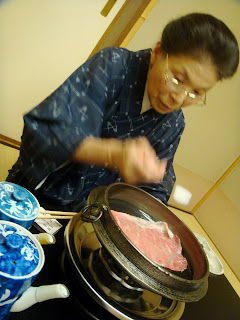
Here you can see both Obasans at work. The plates on the middle of the table are the condiments which were to be added to the ponzu (Japanese citrus based sauce) into which the Shabu Shabu (beef hotpot) meat was to be dipped. They include grated radish, grated radish with red chilli, chives and ginger.


Here the Obasan is preparing the Sukiyaki. First off she started by heating the pan and melting a cube of fat to grease up the pan, then she added a single slice of ribeye and generously sprinkled sugar on it.


She then seasoned the beef with some soy sauce.


...And added some Leeks and sauteed them alongside the beef.


Here is the finished result. The sukiyaki beef is to be dipped in a raw beaten egg. This was my first time having sukiyaki (at least prepared this way) and it was absolutely great. The beef just melted in your mouth and the sugar coupled with the soysauce and egg was absolute heaven.
I am, however, a very health conscious person and I couldn't help but think that this was an extremely calorie dense plate. Luckily, our 10 hours of walking per day exploration routine more than took care of that. :)


Finally some udon noodles to finish things off.


For dessert, we could choose between this custard and a slice of Melon. Naturally, after trying Japanese melon the previous night i went for melon again.


This time it was Shizuoka Melon (Shizuoka being a coastal region southwest of Tokyo), which is white rather than yellow. It was just as good. I now totally understand why fruits are so overpriced in Japan...
The above meal cost around 70,000 JPY (760 USD) for four persons.


The restaurant host had friequented our room several times during the night, always inquiring wether we would like something more to drink. Eventually, having been unimpressed apparently with our meager beers, he said "The madame at Kanetanaka told me that you enjoyed the sake served last night, would you like the same tonight?" he was almost trying to hussle us it seems (the sake that we ordered last night cost 70,000 JPY (760 USD)).
This uncourteous behaviour was the only impolite gesture that we had encountered throughout our stay in Japan. Guess the guy was just a bad host...